Level Design Document – Vineyard
The Vineyard was designed a medium-intensity area for Hidalgo’s Chapter 2, which needed to have many gameplay interactions in a small and limited space. This was my first level I pitched and designed in a professional production, taking it from conceputalization through design, iteration and implementation. Its development spanned roughly a year and a half, evolving alongside the project with changing production needs, cross-department collaboration and several design iterations.

This zone was inspired by Chapter XXXV of the first part of Don Quixote de la Mancha, where he sleepwalked into the inn’s kitchen and “slayed” the wine sacks that were hanging there, thinking they were monsters. We also wanted to represent one of the trademarks of Castilla-La Mancha: the vineyards.
The first thing that I wanted to think about were the wine sacks. I knew I wanted them to be iconic and charismatic, basically like a cute mascot. Wine sacks in real life are the pig’s skin with the limbs and head tied up, which kind of reminded me of the character shape of Patrick Star, from Spongebob. That made me think of chubby and clumsy creatures. But also, the headless part reminded me of the broom servants from Disney’s Fantasia, which made me think about diligent workers.
Combining both ideas, I basically had a very chubby version of the Oompa Loompas that worked in Charlie’s Factory, and that’s where I thought about using that whimsy and bizarre energy for the vineyard itself. I just needed some kind of toy that the protagonist Family would use in their diorama, which would end up coming from the shape of the grapes: a marble circuit.
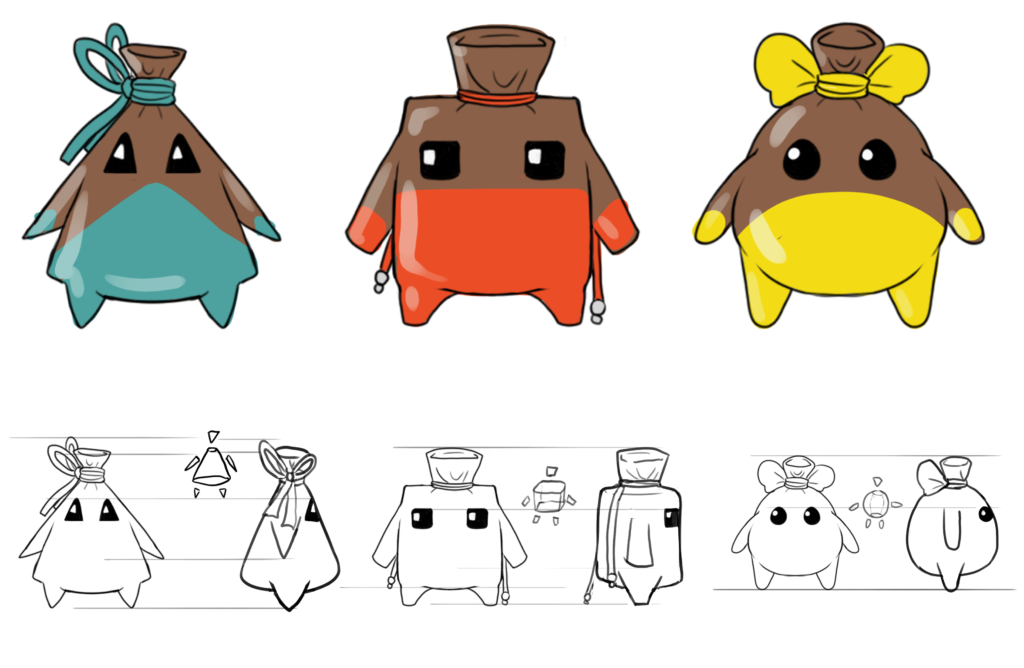
So, to this point, we had a vineyard that had this bizarre and non-sensical pipes that would transport the grapes from the vineyard to a central farmhouse. All of this would be done by stubby and diligent creatures that would walk around the space. But there was something missing, something that both vineyards and Charlie’s Factory had: a leader. So that’s where the figure of a hot-headed and strict antagonist came: the overseer.
And with all of this in mind, I then thought about what the player would be doing. I knew I wanted them to interact with the wine sacks and the circuit, and there would probably be some chaotic shenanigans going on to reference the original work. So I thought about destroying the circuit to throw to the grounds the efforts of the overseer. Some iterations on this idea were done, like having Rucio pushing off pillars or cutting ropes with Quixote. But the final idea came from the wild imagination of a concept artist, that said as a joke that it would be awesome to shoot the wine sacks off with a catapult that used the grapes as ammunition.
So in summary, we had:
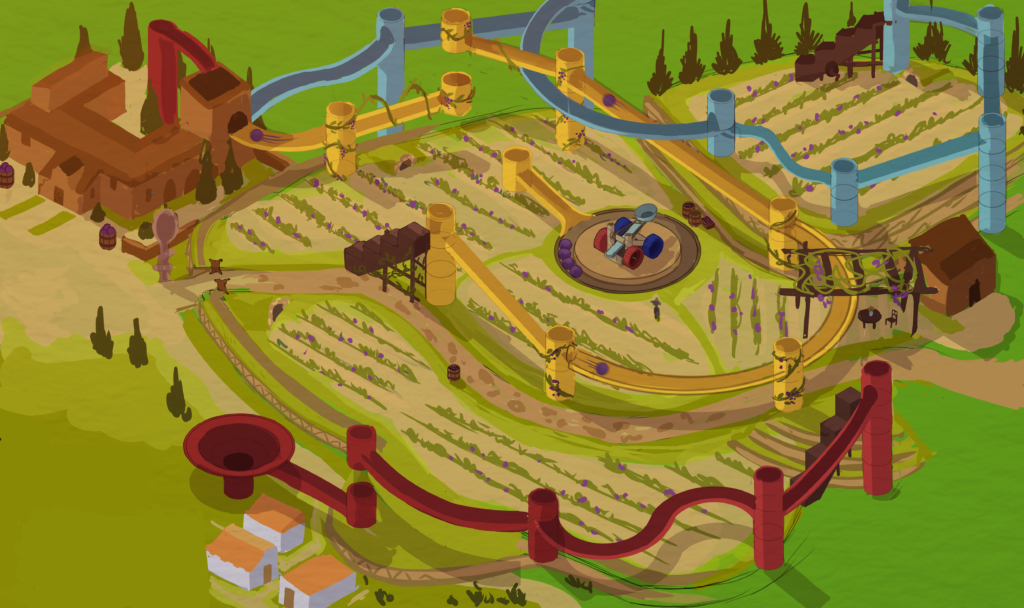
- The location would be inspired by classic and real vineyards from La Mancha, incorporating its element into a whimsical and chaotic structure of pipes that transported the vineyard’s grapes from one location to the other.
- There would be enemies patrolling the area, that would act as loyal employees collecting the grapes and feeding them into the circuit. These workers would look like wine sacks: watery and heavy animations, chubby limbs and inorganic.
- The main antagonist of this area would be the overseer, a temperamental and strict leader that would block off Quixote’s path.
- The player would have to snatch away the grapes from the vineyard to use them as cannon balls with a catapult to destroy the vineyard.
Catapult
The catapult was going to be the main interaction system for the player, and having my Coop Player Persona in mind, I knew I had to make it so that both characters had to interact with it. The answer came pretty quickly: use the Grab action of Sancho to pick up grapes and load it into the catapult, and use the Special Interaction of Quixote with machines to activate it.
However, something was missing: how to aim the catapult. I thought about implementing a whole sequence using Quixote’s first person system, but it was too costly and we were breaking too much the general flow of the game having it become a first person shooter. So I sticked to the already defined Hidalgo’s verbs list, and I picked up the Rotate action that corresponded to the Mother, the secret third playable character.
However, this had some considerations that we had to take into account when designing the puzzle. And that is that the rotation was done by steps, not a continuous movement that would let the player aim wherever they wanted. This meant that we had to define the rotation points of the catapult and, most importantly, where would the player be shooting at.
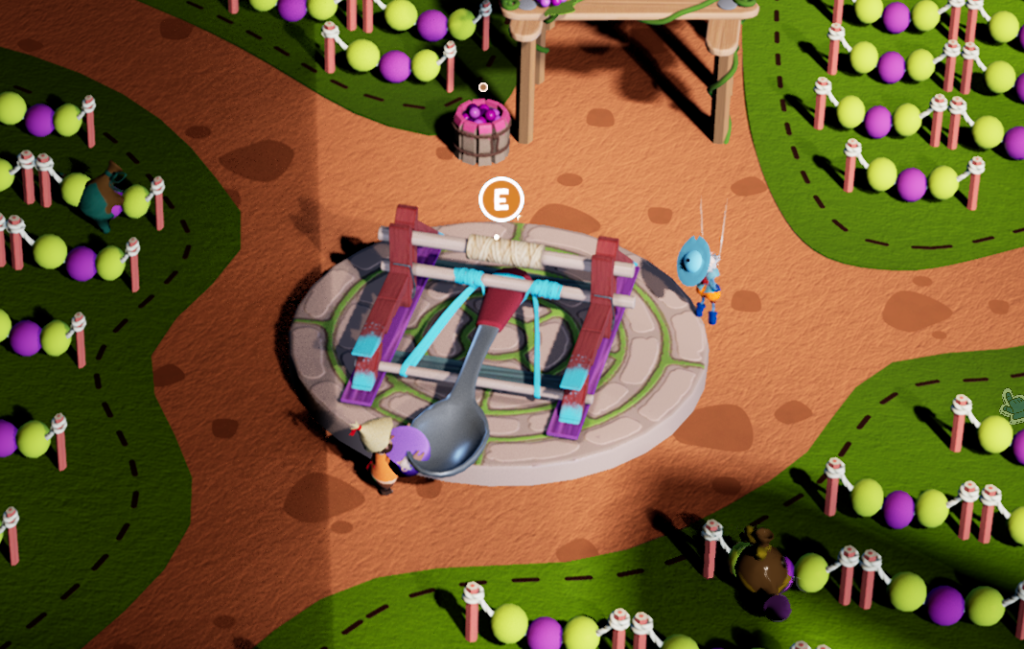
In summary:
- Sancho can interact with the catapult while holding a marble to load it.
- The player can rotate the catapult step by step to change its trajectory.
- While loaded, Quixote can interact with the catapult to fire it.
- When fired, the marble flies directly to a destruction point.
- If the destruction point is active, an animation is played and it becomes inactive.
- If the destruction point is inactive, the marble flies away.
Wine Sacks
The wine sacks would be patrolling the vineyards and collecting the grapes. I knew I had to make a patrolling routine, with of course a switch to an aggresive behaviour. My initial idea was to stick to the classics and just make them aggressive when they spot you; but the creative director was concerned about the players being distracted too much with them. That and making the game too violent.
I liked the idea of having Quixote protecting Sancho while the latter was vulnerable while carrying a grape to the catapult. So I pitched the idea that the wine sacks would become aggressive only when Sancho was stealing from them. Combined with suggesting some more cartoonish animations for the wine sacks to make the combat feel goofy instead of violent, it was enough to convince the creative director.
I ended up defining a state machine of the wine sacks with many behaviours, depending on player state and function of the wine sack itself.
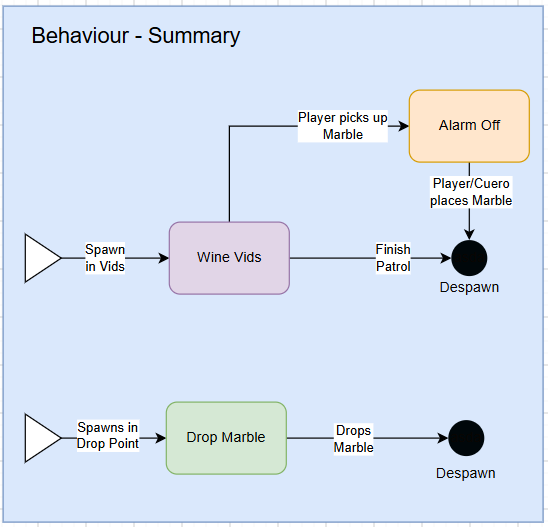
- Patrolling: Idle behavour. It follows a defined route, stop in defined spots to make an animation, gathering if it’s a gathering point or drop if it’s a drop point, and then disappear in a despawner.
- Aggressive: Active when the player is grabbing a marble. They walk towards Sancho holding the marble and stop to attack when he was in range. If the attack didn’t land, it would be stuck in the ground for a while before going back to the aggressive state.
- Recover: If the marble is dropped for whatever reason, every wine sack would immediately walk to it and grab it when reached, and then walk towards the drop point to store back the marble.
- Feed: Extra behaviour for those wine sacks outside the playable area. They spawn with a marble and walk towards a feed point of the circuit. When a wine sack does this, a marble is spawned in the circuit.
Placing Pieces
At this point, I had the feeling that the interaction felt too shallow. You would steal the grapes from the wine sacks, defend yourself from them until you loaded the catapult, aim to the next destruction point and fire the catapult. Looking at this flow, the most interesting point was the combat against the wine sacks, but I couldn’t make it the central piece because, again, it was too violent.
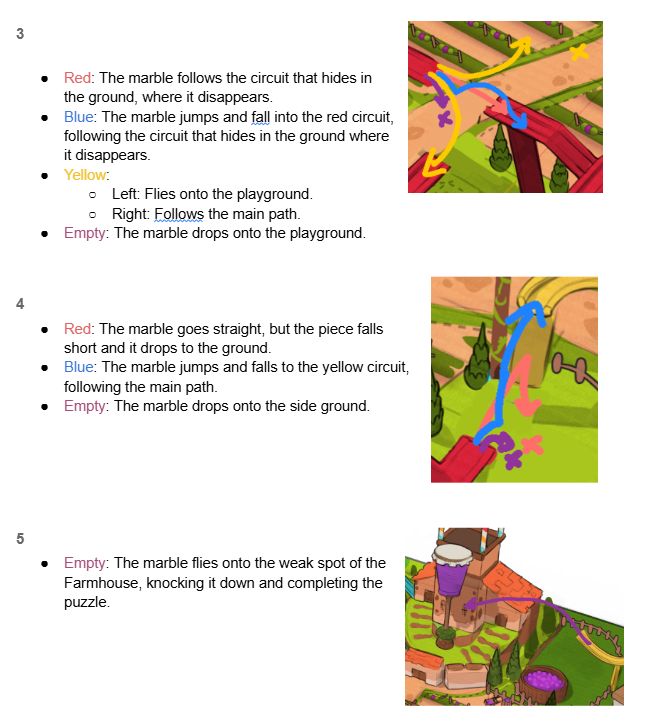
So I thought about doing one more spin using the marble circuit concept. One of the most satisfying things while watching a marble race is watching the butterfly effects go off. So, what if the player could modify the circuit using the Pick Up and Place actions of the Mother? The player would get circuit pieces around the vineyard that would then place in the points that they destroyed with the catapult, making the marble go in a different direction.
And that could be our end goal. To change the trajectory of a marble to make it fly against the overseer, knocking him down and completing the area. That put the overseer in a high place, and having the farmhouse as a waypoint, we decided that the overseer would be on a balcony that would fall off when the marble hit it.
I also wanted the players to be able to rotate the pieces in the placing points and not have only a single position that gave feedback to the player. To account for that, in case that the connection made sense but didn’t correspond with a correct solution, a marble using physics would be spawned and flung to the direction that the piece was facing.
When every destruction point has been destroyed and every piece has been placed in the correct position and rotation, the win condition is met and the ending cinematic would be played.
Before going into the blocking, I like to put in context every mechanic and actually define how they are going to interact with each other. To do that, I create a Player Journey Map with 6 layers:
- Doing: The task that the player will be doing. It can be atomic or more abstract, depending on the abstraction level I’m currently in.
- Thinking: What the player is thinking while doing the task. It helps me go through my Player Persona train thought and understand him better.
- Feeling: What the player is feeling while doing the task. It defines the emotional and general intensity flow of the area.
- Onboarding: To make sure the whole area is properly understood, either explicitly or implicitly, I lay out every piece of knowledge that should be introduced to the player and have everything appear while performing a task, either by a tutorial, a dialogue or camera movement.
- Narrative Overview: I lay out every cinematic or dialogue that I want to have to progress in the story or explain the context, with a briefing on what happens in it.
- Notes: Internal notes I like to take to have in consideration, like specific camera angles, animations or events.
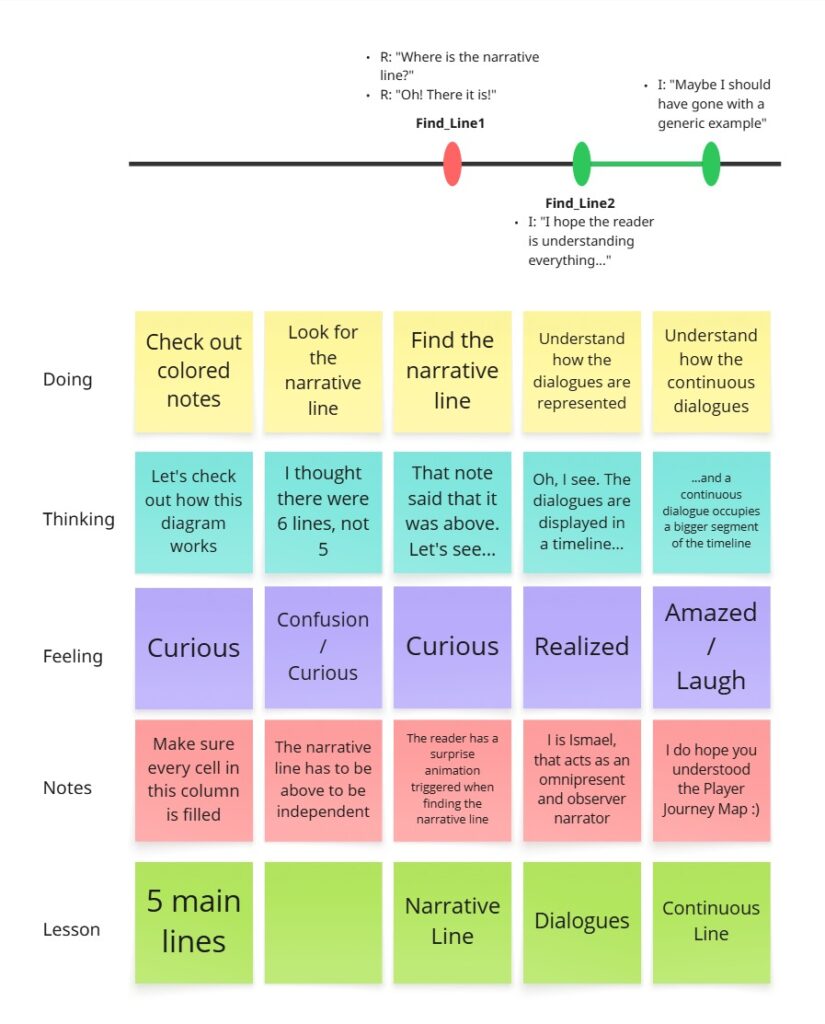
With that in mind, you can check out my Player Journey Map. In summary, the player will:
- Enter the vineyard and be introduced to the overseer, the wine sacks and the circuit.
- Learn how to operate the catapult by trying to shoot the overseer, failing to do so.
- The player is explained that he can defeat the overseer by destroying and reconstructing the marble circuit.
- The player gets to do a couple of shots before start being chased down by wine sacks.
- The player picks up the pieces and place them in the already-destroyed spots.
- The player places all the pieces and destroys all the points, triggering the final cinematic.
- The player leaves the area to continue.
Something to take into account in Hidalgo’s level design is that the space is limited to the size of the Family’s table; meaning that every area has to be contained into a very strict surface. This restriction comes from one of the core principles of Hidalgo, which is to make it feel like you are in a diorama, so it has to be upheld. That’s why the first step is to check the available space.
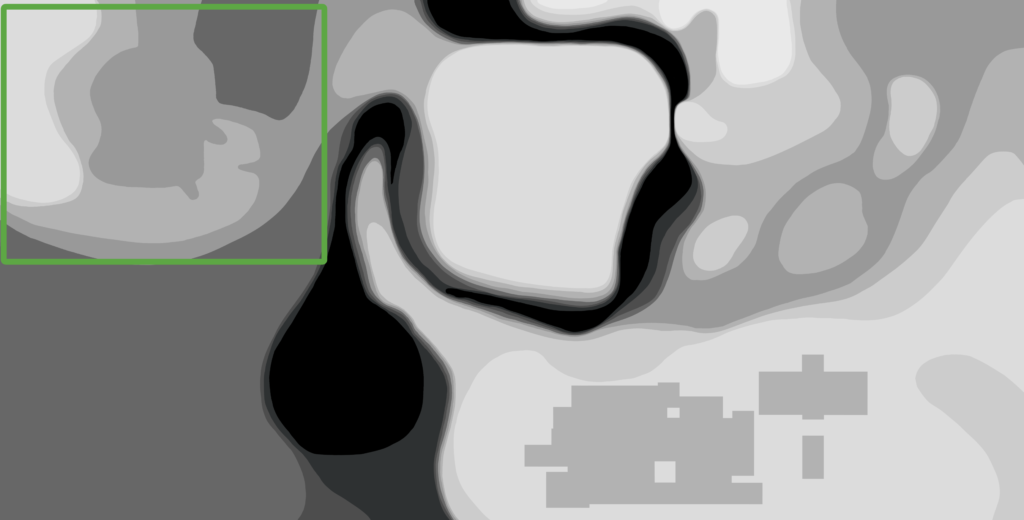
My first instinct was to occupy the better part of the left side, having the circuits be spread out across it. The pieces would be obtained by completing small challenges, like defeating wine sacks or finding the piece hidden in the environment. However, this lead to huge issues coming from the concept team, specially regarding the final circuit shape after the player’s actions.
That’s when I thought about doing a blocking in-engine, but here is where I comitted a costly mistake. I took it upon myself to find the exact shape of the circuit, including how the tubes would bend. But not only I overstepped into concept territory, but also failed to realize I should plan and define measurements. The results were not great, but after talking with the art team, we changed strategies.
First step: identify restrictions, and the biggest one was the radius of the catapult. We could take some artistic liberties about the trajectory of the projectile, but the destruction points should be around the same distance from the catapult. So I decided to place the catapult at the center of the area, and then make a circle around it. That’s where the circuit would be, so I placed 5 destruction points at equal distance between each other around the circle. The art team and me decided that there would be 3 different circuits, and that the connecting pieces the player needed to place would be in the intersection between them, so that’s where the 3 placing points would be.
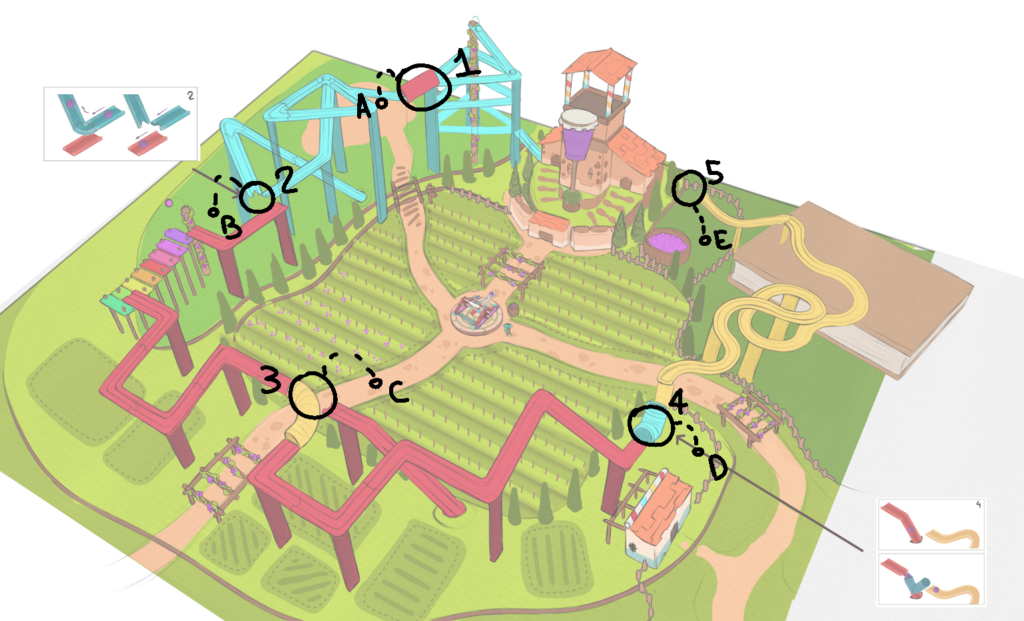
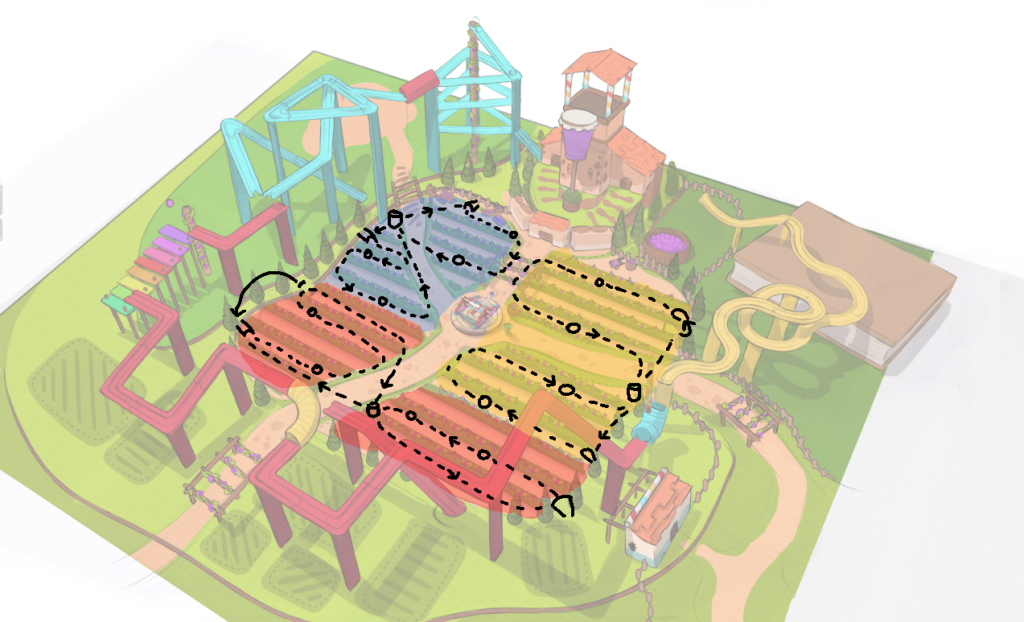
And with these considerations, the concept art team stepped in and worked on a circuit shape that would be cool to see but easy to read. After some back and forth, we ended up on the design we finally had, and they even gave us a mesh with the general shape of it.
Having the space defined, I could take the player journey I previously defined and define a series of events and dialogues that would guide the player through the action. To do this task, I started working on a narrative flow that defined the differents events and triggers, as well as a list of moments that would happen during that event like spawning an object or a specific animation. The general sequence goes like this:
- Quixote and Sancho reaches the vineyard and triggers the initial cutscene. Their mounts disappear and the way out is blocked. The catapult is activated.
- The player loads and fires the catapult. It triggers a cutscene to explain that the objective is to modify the circuit around the vineyard. Catapult rotation is activated.
- The player destroys the first piece of the circuit. It triggers a cutscene to explain how to place pieces.
- Positive feedback is given when the player correctly places the pieces.
- When the player grabs the third marble, a cutscene is triggered where the overseer gets mad and orders the wine sacks to attack the characters.
- Additional cutscenes without dialogue are triggered when the player grabs the fourth and fifth marble.
- Final cutscene is triggered when the win conditions are met. The block to the next area disappears.
With this narrative flow in hand, I would then go to Articy, a tool made to manage dialogue trees and narrative design, and write every dialogue I identified in the previous steps. In these diagrams, I specify when every moment I wrote in the narrative flow would happen. These dialogues would later be revised and rewritten if necessary by our writers, based on the general purpose of the scene.
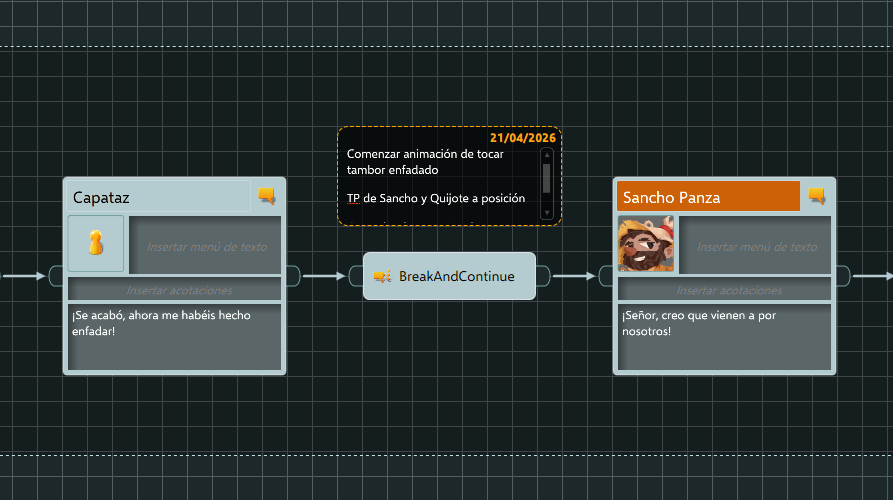
Finally, I would go to Unreal to create every necessary Sequence, either to have a specific camera angle, camera movement or character animation. I would lay out marks related to when each event would be triggered, each linked to a moment I previously wrote in Articy.
The vineyard will always hold a special place in my heart, since it was the first level I’ve ever pitched in a professional production. But that also means that I had tons of lessons not learnt yet, so in many ways, I built the vineyard alongside my skills as a designer. In retrospect, there are a lot of things I should have done way earlier:
- Test concepts sooner than I did to make decisions early-on for challenges like, for example, how the marbles would move.
- Cooperate more with my team, not only to make early concepts or prototypes, but also to make them part of the process and align our visions.
- Ask about needs instead of predict them, because there were times where I would go down a rabbit hole and not focus and what was important.
- Facilitate other departments’ craft, not try to solve it for them. Specially since the best solutions come from the mix of ideas.
Many of these mistakes were costly, and I even had to give up some elements I would have liked to make. For example, I would have wanted to make some specific pieces to knock down structures that would reveal optional collectibles. However, since I didn’t define it early enough, by the time I explored it the shape of the vineyard was too advanced to accommodate it without changing the whole area.
Leaving ideas behind always makes me sad, but it taught me many valuable lessons about early validations, communication and planning across departments, and how a well done pre-production can save time in production; something I’m noticing now while working on Chapter 3.
Despite the challenges, I am proud of what we have built and I’m very grateful to the vineyard for teaching me these lessons.
Disclosure: Project is owned by Infinite Thread Games. Images and videos used with authorization for profesional portfolio.